Infolinks Ads

Pages

Wednesday, 10 August 2011

2012 Acura TL 6-Spd AT


Overview
Now in its fourth generation, the TL is Acura's sales leader and far away the brand's most important vehicle; this much can be concluded by simply examining the many configurations on offer. The TL can be had with either front-wheel drive or Super Handling All-Wheel Drive (SH-AWD), a choice of a 3.5- or 3.7-liter V-6 and one of two transmissions; a 5-speed automatic or 6-speed manual.The recently introduced 6-speed is optional on SH-AWD-equipped TLs that come standard with a 305-horsepower 3.7-liter V-6 - the most powerful Acura engine ever built. This TL SH-AWD 6MT, as it's rather inelegantly known, replaces the last generation TL Type S and is the sportiest TL in Acura history. At the other end of the lineup is the base model front driver, which receives the 280 horsepower 3.5-liter V-6 and lackluster five speed auto as standard equipment.Mainstream acceptance has been slow in coming for Acura's signature front grille, but behind this bright beak is a surprisingly capable and composed sports sedan that loves to run hard.

The Range

Bodystyle: Sedan
Engines: 3.5L, V-6 3.7L V-6
Transmissions: 5-speed automatic, 6-speed manual
Models: TL, TL SH-AWD, TL SH-AWD 6MT

What's New

TL was completely redesigned in 2009 so changes are at a minimum. The biggest news is the TL SH-AWD 6MT model which features an all-new close-ratio 6-speed manual and clutch, as well retuned front springs and dampers, unique electric power steering tuning, and a recalibrated SH-AWD system. Also added to the 6MT model are heavy duty front drive shafts, CV joints and front differential.

Exterior

Beyond the beak is a striking, well-proportioned sedan, with a futuristic edge like nothing else on the road. It is best viewed from behind, which is all the more reason to keep viewers back there.

Interior

The best view of the new 2011 TL might be from behind the wheel, where cool metallic tones, tight tolerances, and crisp, gauges create a high tech, if button driven, environment. The 6MT is definitely the driver's choice.

Performance & Handling

The TL's 3.7-llter V-6 is a free-revving gem that only reaches full potential with the 6-speed manual. Both automatic versions are deft handling sedans that cruise comfortably and reward spirited driving, but both sorely need the new 6-speed transmission found in the MDX and ZDX. SH-AWD works well, but will not be missed by slow drivers or Sunbelt dwellers.

Safety

Four airbags and active head restraints for the driver and front passenger come standard as do various braking aids and stability/traction control. All seating positions have three point belts, while outboard passengers have side curtain airbags.

EPA Fuel Economy

TL: 18 mpg city/26 mpg hwy
TL SH-AWD: 17 mpg city/25 mpg hwy
TL SH-AWD 6MT: 18 mpg city/26 mpg hwy

2012 Acura TL


The 2012 TL is a 4-door, 5-passenger luxury sedan, or luxury sports sedan, available in 7 trims, ranging from the 6-Spd AT to the 6-Spd AT SH-AWD w/ Advance Pkg.

Upon introduction, the 6-Spd AT is equipped with a standard 3.5-liter, V6, 280-horsepower engine that achieves 20-mpg in the city and 29-mpg on the highway. The 6-Spd AT SH-AWD w/ Advance Pkg is equipped with a standard 3.7-liter, V6, 305-horsepower engine that achieves 18-mpg in the city and 26-mpg on the highway. A 6-speed automatic transmission with overdrive is standard on both trims.

The 2012 TL is freshened for 2012. 

Here’s a mind game I sometimes like to play: imagine your car was destroyed by some horrible accident while you were away (e.g., Godzilla was in the neighborhood). To your good fortune, your insurance company gave you a sufficient settlement to buy a brand new version of whatever it was you were driving. Would you consequently buy that brand new car, or something else with the same money?


We’ve got a 2005 Acura TL, manual transmission + satnav, purchased new back in the day and currently with a modest 60K miles on the clock. It’s driven cross-country. It’s driven to the supermarket. It’s had parking lot abuse. It’s had toddler abuse. And it keeps on running. I had it in the shop recently for it’s “B2″ service (oil change, assorted air filters, and wipers: $230 — whee!) and to fix what turned out to be a busted power steering pump ($450 or thereabouts). Of note, the dealer gave me a chance to play my imagination game by loaning me a brand new 2012 Acura TL (automatic transmission, no satnav, no options at all). With one day of driving it around, here are my observations.

Several things have decidedly improved. The seats seem more comfortable and supportive, and the driver’s seat now includes a power lumbar bolster. The car suspension has radically improved (alternately, our 2005 TL’s has seriously degraded). On the cracked up, uneven streets around our house, the new TL is significantly more composed. You still feel the bumps, but you’re less worried that they’re going to destroy your car. It’s similarly better mannered on the freeway. This is a car you’d love to drive cross-country. Some of the smaller electronic gadgety bits have also improved. I’m happy to see a proper tire pressure monitoring system and an auxiliary music input for phones and whatnot. (I didn’t have time to see how well it does at integrating music from my Android phone via USB much less Bluetooth Audio, but the Bluetooth pairing process was painless enough and Bluetooth Audio (A2DP) is claimed to be supported, albeit with .
Like the 2005 Acura TL, several things are good, but still frustratingly not quite right. Freeway mileage is excellent and stop-and-go city mileage is an embarrassment; I clocked 31mpg highway and from 13-20mpg stop-and-go city — a marginal improvement on the freeway and a marginal downgrade in the city compared to what our 2005 TL gets.
The car has zillions of things you might like to configure, like what happens when you click the unlock button on your remote. Does it just unlock the driver door or the whole car? Many such settings are handled with the arrow buttons on the steering wheel and the tiny screen between the tach and speedo. That’s good. But, how about that giant selector knob with the huge screen above the center stack? It’s only good for changing the radio station and setting up the audio balance. Similarly, the Bluetooth pairing process can only be done via voice, which talks to you slowly. Very slowly. With modern in-car networks, you’d think they could do everything on the big central screen, making it easier, providing more help with options, etc.  Could they, should they centralize all these disparate systems, from no-doubt unrelated parts suppliers, to have a grand unified user interface? Could it be accomplished without reaching iDrive levels of incomprehensibility? For the 2005 TL, such thoughts would have been future fantastic. For the 2012 TL, such thoughts should be entirely achievable. Everything in the car is networked together. Make it so!

Frustratingly, several things have gotten decidedly worse. Foremost is the trunk. If you’re loading something heavy, you’ve now got a 10.5 inch lip to hoist your bags over, versus 7 inches in the 2005 TL. Why? Similarly, if you’re going to the airport, one giant wheely bag will fit without issue, but two of them? Good luck with those bumps on the floor. You can’t blame AWD, since this particular car is FWD. So, again, why? Also from the Department of Fail, you’d think they’d test a family car with family accoutrements like a booster seat. I’ve included a photo of my daughter’s booster seat. You’re supposed to run the seatbelt under both armrests. See the belt latch? It’s way around the back. The old TL was better in this regard, but stil not great. Why not have more slack in the belt latch? (Credit where credit is due: they significantly improved access to the LATCH anchors for younger kids’ car seats.)

Another concern is trying to park this thing into a tight space. The car’s beltlines are higher up and the car feels enormous. It’s notably trickier to park and maneuver in tight environs. Does anybody test these things? I’ll also insert a gripe about the ventilated seats (not present on my loaner car). If I read the options list correctly, it’s not possible to get a manual transmission and ventilated seats, at any price. Really? Do Acura engineers like sitting in a car with Godzilla barbecuing their backside? Do customers who want manual transmissions always wear Nomex racing suits? Hop in my car after a day outside in the Houston summer…

Cosmetically, I’m pretty happy with the new schnoz. It won’t win any beauty contests, but at least it doesn’t cry out for you to put it out of its misery. Also in the cosmetic department, they’ve redone the dashboard and center stack. The gauges are bright and readable, as always. Somebody smart said they should get rid of the blue halos around the old gauges. Somebody less smart decided to add giant fake-chrome rings around them, in a perhaps-confused nod at a Porsche 911. Please revisit the clean, spartan gauges of the previous-generation Acura TSX. No really, please do. Also, I’m baffled by the curvy/slashy lines inside the car. Has somebody been spending too much time looking at.

So, if Godzilla paid an unfortunate visit to my car and I hit the insurance jackpot, would I buy the new TL? Sadly no. But what? Does anybody make a car with a manual transmission, rear wheel drive, decent tech and luxury features, decent mileage yet good performance, good styling, and high reliability ratings? At any price at all? Yeah, fantasies never quite work out, do they?

2011 Dodge Caliber C


What's New for 2011

The 2011 Dodge Caliber receives improved steering feel, additional functions for the navigation system and standard stability control for most trim levels.

Introduction

A while back, Chrysler revived one of its earlier slogans that boldly stated: "In the car business, you lead, follow or get out of the way." Obviously, the brand's marketing execs were hoping to convince people that they're leading. But with vehicles like the 2011 Dodge Caliber, it's still very much a case of following.
Based on specs, the Caliber would seem to be very much in the mix. In terms of size, this entry-level Dodge model resides in a sort of middle ground between hatchbacks and small crossover SUVs (though it's still classified as a compact four-door hatchback). A choice of two four-cylinder engines is offered, and the Caliber can haul about as much cargo as other hatchbacks. But in actual execution, it still ends up being pretty mediocre.
Disappointingly, the Caliber lacks the lively performance characteristic of this category. Handling ability and power output from either engine are middling at best. Even some of the Caliber's unique features -- a built-in beverage cooler, rechargeable flashlight and flip-down liftgate speakers -- seem more like curious novelties than enticements. The quality of the interior is also a bit of a disappointment, despite it undergoing a makeover last year.
We recommend looking at segment leaders like the Hyundai Elantra Touring, Mazda 3, Scion xB, Toyota Matrix and Volkswagen Golf before settling on the 2011 Dodge Caliber. All of these alternatives offer significant performance and interior quality advantages. In the end, Chrysler's tag line has rung true, but perhaps not in the way the company intended.

Body Styles, Trim Levels, and Options

The 2011 Dodge Caliber is a compact four-door hatchback offered in five trim levels. The entry-level Express model comes standard with 15-inch steel wheels, heated outside mirrors, air-conditioning, cloth upholstery, 60/40-split-folding rear seats, full power accessories, remote keyless entry, cruise control, a tilt steering wheel, an in-dash beverage cooler, an auto-dimming rearview mirror, Bluetooth connectivity and a four-speaker AM/FM/CD stereo with auxiliary audio/USB jacks and satellite radio.
Stepping up to the Mainstreet trim level adds 17-inch alloy wheels, a chrome grille, a sportier suspension, foglights, a tachometer, a power-adjustable driver seat, a fold-flat front passenger seat, reclining rear seatbacks and a rechargeable flashlight.
The Uptown model gets you rear disc brakes (versus drums), automatic climate control, leather upholstery, a leather-wrapped steering wheel, heated front seats and a premium nine-speaker Boston Acoustics audio system with steering-wheel-mounted controls and flip-down speakers in the liftgate.
The sporty Caliber Heat takes the Mainstreet model's equipment list and adds 18-inch polished alloy wheels, chrome exterior trim, sport-tuned suspension and steering, rear disc brakes (versus drums) and specialized cloth interior trim.
Building on the Caliber Heat is the Rush, which adds a larger 2.4-liter engine, 18-inch chrome-clad alloy wheels, a rear spoiler, automatic climate control, leather upholstery and a premium audio system with a touchscreen interface and 30-gigabyte hard drive.
Many of the options found on the upper trim levels are offered as options on the lower trims. Additionally, a sunroof and a navigation system are also available.

Powertrains and Performance

The front-wheel-drive 2011 Dodge Caliber is offered with a choice of two different four-cylinder engines. A 2.0-liter engine rated at 158 horsepower and 141 pound-feet of torque is standard on all trim levels except the Rush. The Rush gets a 2.4-liter that makes 172 hp and 165 lb-ft of torque. This engine is optional on the Uptown. Transmission choices include a five-speed manual for the Express, Heat and Rush, while a continuously variable automatic transmission (CVT) is standard on the Mainstreet and Uptown. The CVT with manually controlled simulated stepped gears is offered on the Heat and Rush as an option.
Fuel economy is decent across the board, though mileage suffers slightly with the CVT. The 2.0-liter engine returns EPA estimates of 24 mpg city/32 mpg highway and 27 mpg combined with the manual transmission, and 23/27/24 mpg with the CVT. The larger 2.4-liter engine is nearly as good, with EPA ratings of 23 mpg city/29 mpg highway and 25 mpg combined for manual-transmission-equipped models, and 22/27/24 for versions fitted with the CVT.

Safety

Standard safety features for the 2011 Caliber include a driver-side knee airbag, side curtain airbags, active front head restraints and antilock brakes (rear drums for the Express and Mainstreet, four-wheel discs for the other trims). Stability control isn't available on the Express but is standard on the remaining trim levels. Front-seat side airbags are offered as options for all but the Express trim.
The Caliber has not been rated using the government's new, more strenuous 2011 crash-testing procedures. Its 2010 ratings (which aren't comparable to 2011 tests) resulted in a perfect score of five out of five stars in both frontal and side impacts. Results were mixed in Insurance Institute for Highway Safety tests, however, with a top "Good" rating in the frontal-offset tests and a next-to-lowest "Marginal" rating in side-impact tests.

Interior Design and Special Features

Among competing hatchbacks and crossovers, the 2011 Dodge Caliber's interior ranks midpack. There are plenty of hard plastics inside, but a cabin makeover last year added cushioned materials in key touch points. A decent amount of head- and legroom ensures comfort for front and rear passengers, while the driver benefits from good outward visibility, legible gauges and intuitive controls.
More noteworthy is the Caliber's practicality, with 60/40-split-folding rear seatbacks and a flat load floor to accommodate bulky items. All but the Express trim models (with its flat-folding front passenger seat) can accept longer items, like surfboards or lumber while still being able to close the rear liftgate. Maximum cargo capacity is 48 cubic feet, which is comparable to other hatchbacks, but considerably smaller than some compact crossovers. The Caliber also features some road-trip convenience, adding a beverage cooler built into the glovebox that holds four 12-ounce cans.

Driving Impressions

One word to describe how the 2011 Dodge Caliber drives: mediocre. It neither impresses nor really offends behind the wheel. Acceleration is listless with the base 2.0-liter engine and only slightly improves with the 2.4-liter. Either engine, however, is further hindered when saddled with the CVT.
The Caliber's ride quality is generally acceptable, though the sport-tuned suspension in the Heat and Rush models may be too rough for some. Handling, too, is adequate but drivers seeking excitement should look to other hatchbacks or crossovers.


Following up on last year’s interior redo, Dodge has made more changes to its compact Caliber for 2011. Unfortunately, shedding theintroduced for 2010 was not among the alterations; as a refresher, they are Express, Mainstreet, Uptown, Heat, and Rush.
Changes across the board include the addition of six new paint colors with whimsical names like Mango Tango and Redline 2. Stability control becomes standard on all but the Express trim level, and the optional navigation system gains Sirius traffic information. A new 18-inch chrome wheel design is available for Uptown models.
There are only slight mechanical updates: All models except the Express get revised steering, while the Heat and Rush receive retuned shocks and a thicker rear anti-roll bar. The Caliber’s thrashy, unrefined powertrains are regrettably unchanged. The base engine is a 2.0-liter four-cylinder rated at 158 hp and 141 lb-ft of torque, while a 2.4-liter four with 172 hp and 165 lb-ft is standard on Rush and optional on Uptown trims.


THE 2011 CHEVROLET MALIBU


As shown(1): $27,165

With more than 40 awards to its credit, the Chevrolet Malibu continues to command attention and acclaim with praise such as, "Chevrolet Malibu hits a high-water mark for its size and price with taut proportions, elegant lines and a crisp.
THE 2011 CHEVROLET MALIBU
EXTERIOR
Malibu's world-class design and superb level of craftsmanship have earned the respect of people who know cars.
Acoustic Laminated Glass
The same concept used in expensive luxury cars - helps create a barrier to reduce unwanted noise.
Bright Lights
Malibu LTZ features taillamps with clear lenses and LED illumination.
18" Wheels
New 18" five-spoke Chrome-Tech aluminum wheels are available on 2LT as part of available Engine Package.

INTERIOR

Meticulous Attention to Quality
You'll be impressed by the nearly microscopic gaps - many as tight as 1mm - in the interior fit and finish.
Thoughtful Conveniences
From the dual cockpit to the sculpted door panels, one detail flows seamlessly into the next. There's a Driver Information Center, featuring an outside temperature gauge, Tire Pressure Monitor(12), and readouts for range and instant/average MPG.
Leather Appointments
Inside the leather-appointed LTZ interior, the heated driver seat includes an eight-way power adjuster and power lumbar control, while the heated passenger seat features a six-way power adjuster.
Upscale Details
Rich textures please the senses. A Remote Vehicle Starter System even pre-cools your Malibu LTZ on hot days or preheats it on cold days.

PERFORMANCE
33 MPG Highway: Advantage Malibu
With 33 MPG highway, (12) Malibu LTZ offers fuel economy that a comparable Toyota Camry can't match. That means up to 528 highway miles on a single fill-up. A six-speed automatic transmission, standard on all models, helps maximize performance and fuel efficiency. Malibu engines feature Variable Valve Timing (VVT) - a technology that optimizes combustion, enhances low-end torque and helps lower tailpipe emissions. A 252-hp 3.6L engine with dual overhead camshafts and VVT is available on 2LT and LTZ. Fuel economy for this engine is 26 highway and 17 city.(4)
TECHNOLOGY
Technology That's There For You
It's great to have all the latest gadgets and modern technology, right at your fingertips.
Turn-by-Turn Navigation
OnStar Turn-by-Turn Navigation (8) (standard for the first six months) offers you a live Advisor to help - even if you don't know the full address. Just push the OnStar button and an automated voice calls out directions. You can also plan ahead with eNav(14) at MapQuest.com and send your destination to your Malibu before you go.
Hands-free Calling
Bluetooth®(13) wireless technology for select phones lets you make, answer and end calls with a tap of the steering wheel controls. Available on LS and 1LT, standard on 2LT and LTZ.
Vehicle Diagnostics(8)
OnStar automatically performs several hundred diagnostic checks on your vehicle and emails you a monthly report. These reports include tire pressure readings, remaining oil life, engine and transmission system checks, air bag system checks and more. Standard for first six months.
Show more features

PROTECTED & CONNECTED WITH ONSTAR

SAFETY/CAPABILITY
A "2010 Top Safety Pick"
Chevrolet Malibu offers the unsurpassed lifesaving technology of OnStar®.(8) And the Insurance Institute for highway Safety has rated the 2010 Malibu a "Top Safety Pick"(9) That's an achievement unmatched by Honda Accord or Toyota Camry. Standard Malibu safety features include:
  • OnStar®(8) service for the first six months with Automatic Crash Response
  • StabiliTrak Electronic Stability Control System
  • Six air bags(11)
  • StabiliTrak Electronic Stability Control System
  • Progressive crush front body structure
  • Four-wheel antilock brakes
Standard StabiliTrak
StabiliTrak Electronic Stability Control System assists the driver with directional control of the vehicle in difficult driving conditions. Sensors continually monitor the path being steered by the driver, and the direction that the vehicle is actually turning. If StabiliTrak detects a difference, it selectively applies brake pressure to the appropriate wheel to help pull the vehicle back to the path being steered.
Automatic Crash Response
Every Malibu offers the security of OnStar(8) with Automatic Crash Response standard for the first six months. In the event of a collision, built-in sensors can automatically alert an OnStar Advisor, who is immediately connected into your vehicle to see if you need help sent to your exact location - even if you can't respond. 
Six Air Bags - Standard
Every Malibu features dual-stage driver and front passenger air bags(11) with the Passenger Sensing System, thorax and pelvic side-impact air bags, and head-curtain side-impact air bags for front and rear outboard occupants.


Wednesday, 20 July 2011

2011 Toyota Venza FWD I4


With one very configurable trim level, the Venza offers a range of possibilities. The Venza successfully combines the comfort and refinement of the Camry with the cargo-carrying capacity of a wagon. The all-wheel drive option means the Venza is sure-footed in any situation. The base engine earns a 21 mpg city and 27 mpg highway rating from the EPA, while even the all-wheel drive with a V6 gets 18 mpg city/25 mpg highway.
There is only one Venza trim, which keeps things simple, but it does have quite a few options, starting with the engine. The 2.7L 4-cylinder makes 182 hp and 182 lb-ft of torque; the 3.5L makes 268 hp and 246 lb-ft of torque. Either engine can be had with front-wheel or all-wheel drive and a 6-speed automatic transmission is standard across the board.

The Venza has SUV touches like 4-wheel independent MacPherson strut suspension and a reasonable 3500 pound maximum towing capacity. It also has safety systems such as anti-lock brakes with brake assist, traction control and electronic brake force distribution. The Venza also includes Smart Stop Technology, which reduces engine power when the brake is firmly applied to bring the vehicle to a stop, even if the gas pedal is being pressed. Further safety systems include front airbags, front and side curtain airbags, driver's knee airbag, tire pressure monitoring and hill start assist.

Venza comes standard with creature comforts like dual-zone climate control, 6-speaker stereo with CD/MP3/iPod/Bluetooth capabilities, 8-way power driver's seat, cruise control, illuminated cup holders and rear-seat reading lamps. The cloth seats can be upgraded to leather with heat, and the carbon-fiber style standard interior trim can be swapped for the optional mahogany woodgrain-style trim. A backup camera, a voice-activated navigation system and a rear-seat DVD system are also available.
Very little has changed for the 2011 Venza, as it was a brand-new model in 2009 and hasn't needed even a refresh yet. Four-cylinder and 6-cylinder engines are available, as is all-wheel drive. The Venza holds the distinction of being the first Toyota passenger car with the STAR Safety System as standard equipment.
SUV styling with passenger-car comfort; choice of engines and available all-wheel drive; spacious interior
With one very configurable trim level, the Venza offers a range of possibilities. The Venza successfully combines the comfort and refinement of the Camry with the cargo-carrying capacity of a wagon. The all-wheel drive option means the Venza is sure-footed in any situation. The base engine earns a 21 mpg city and 27 mpg highway rating from the EPA, while even the all-wheel drive with a V6 gets 18 mpg city/25 mpg highway.

2011 Toyota Venza AWD


Toyota has endured some tough knocks lately, with a series of recalls over the past year, as well as constantly being lambasted by critics for having "boring" cars. The Venza crossover breaks out of Toyota's safe and conventional mold, at least from a styling standpoint.
The 2011 Venza is a 4-door, 5-passenger sport-utility, available in 4 trims, ranging from the FWD I4 to the AWD V6.
Upon introduction, the FWD I4 is equipped with a standard 2.7-liter, I4, 182-horsepower engine that achieves 21-mpg in the city and 27-mpg on the highway. The AWD V6 is equipped with a standard 3.5-liter, V6, 268-horsepower engine that achieves 18-mpg in the city and 25-mpg on the highway. A 6-speed automatic transmission with overdrive is standard on both trims. 

In total passenger volume, the Highlander trounces the Venza by more than 37 cubic feet. In cargo capacity, the Venza's Celtic-themed kin bests it by more than 10 cubic feet with the rear seats up, and by a substantial 25 cubic feet with the rear seats folded. Max towing capacity on the Highlander is also 1500 pounds greater than on the Venza, with a nearly identical powertrain. The key difference? The V-6 Highlander still soldiers on with a five-speed automatic, while the V-6 Venza gets a six-speed.The one, and increasingly important, area in which the Venza bests its larger sibling is fuel economy. The all-wheel-drive V-6 Highlander rates 17/22 on the EPA cycle, with the sleeker, 400-pound lighter Venza AWD returning 18/25. For those seeking even greater fuel economy, the Venza is also available with a 2.7-liter four-cylinder shared with the base Highlander that returns 21 city and 27 highway mpg on the front driver, and 20/25 on the all-wheel-drive model. Considering the minimal fuel economy penalty with the V-6, and the fact it offers 86 more horsepower, go with the six.
As with many current Toyotas, the driving experience isn't especially engaging. However, considering the vehicle's intended mission, canyon-carving probably wasn't a high priority on the suspension engineers' checklist. Getting back to the theme of sacrificing function for beauty, however, the 20-inch wheels deliver a ride firmness that hints at handling prowess that the suspension simply can't deliver. Taking a corner at anything more than a moderate pace elicits screeches and and howls from the tires. Appreciate the dubs for their style, but don't expect dramatic performance.
Although the Venza cuts an unmistakably dashing profile on the outside, the interior is a mixed bag. There's nothing exceptionally objectionable about the styling or materials, but the interior does not have the same cohesiveness and elegance as the exterior. There's an odd, indeterminate texture applied across much of the interior plastic that is an attempt at a woodgrain or faux leather, but succeeds at neither. A similar and more subdued texture is applied on the leather seats, and it works a little better, but still comes across as a bit contrived.
Ergonomically, the Venza is somewhat of an adjustment. When I first sat down and oriented myself with the controls, I looked around for a display readout for the air conditioning controls. Somewhat counterintuitively, the temperature and fan settings are displayed on a 3-inch-square LCD display in the middle of the dashboard, up high in a central unibrow area. It's not that jarring once you get used to it, but the placement seems like an afterthought.
Compared to its most logical peers, the Honda Crosstour, Nissan Murano, and Ford Edge, the Venza offers similar capabilities. Comparably equipped, the prices are pretty close, too. So what is there to recommend the Venza over its rivals? Well, if you're predisposed to think favorably of Toyota products, it has that going in its favor. It's the best-looking of the bunch, especially from a rear three-quarter angle. However, the interior has the oddest layout and materials.
Toyota often has mixed results when it tries to be too edgy, and the Venza is a rolling example. While the exterior is stylish and eye-catching, the interior is an odd mishmash of unique and parts-bin, premium and low-rent. If I were in the focus group for a mid-cycle refresh, I would suggest a revamp of the interior, using soft-touch, conventionally textured plastics, quality leathers, and contrast stitching. And perhaps some memory functions for the steering wheel adjustment and driver's seat.The danger in moving too upscale with the Venza is that it would quickly start stepping on the toes of its more patrician cousin, the Lexus RX, in both price and market positioning. Such is the peril when you also have a luxury brand in your portfolio.
As it stands, the Venza is a stylish alternative to the conventional midsize SUV, and would likely fit the needs of small (two or fewer children) families looking for day-to-day family transport. With some fine-tuning to the interior trim, it could be a great crossover instead of a good one.

Monday, 11 July 2011

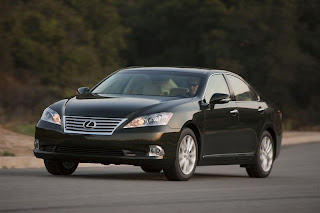
2011 Lexus ES 350


Re-rating the ES 350 to use regular unleaded brings a power loss of 4hp & 6lb.ft of torque, but the savings at the pump are sure to make up for such a minor decrease. Even more than that, it’s a smart move as more and more cars move into direct competition with Lexus’ best selling sedan.
For the full details on the 2011 ES 350, I’ve included the press release after the jump.

Lexus ES 350 Continues to Symbolize Luxury and Style

• Lower Cost of Ownership with Regular Fuel
• Standard 10-Way Power Front Seats and Leather Trim Provide Interior Oasis
• Standard  Brake Override System

After amenity upgrades and styling enhancements last year, the Lexus ES 350 cruises into the 2011 model year using 87-octane regular fuel.  2011 ES 350 customers will continue to enjoy a smooth and quiet ride as the cost of ownership is reduced.  With the new fuel recommendation of 87-octane gasoline, the ES 350 generates 268 horsepower and has EPA fuel economy estimates of 19 miles per gallon in the city and 27 on the highway.  ES 350 will be enrobed with one new exterior color, Deep Sea Mica, which replaces Black Sapphire Pearl.

Engine/Transmission/Drivetrain/Performance
The ES 350′s aluminum 3.5-liter V6 produces 268 horsepower at 6,200 rpm and 248 lb.-ft. peak torque at 4,700 rpm. The chain-driven camshafts employ Dual Variable Valve Timing with intelligence (Dual VVT-i) for optimal performance and efficiency at all engine speeds.

The six-speed automatic Electronically Controlled Transmission with intelligence (ECT-i) provides a sequential manual shift feature for a more involved driving experience when desired. Shifting strategy adapts to driver input, with rapid downshift response.

Chassis/Body/Suspension/Tires/Brakes
The ES 350 owes its smooth, quiet ride in large part to a rigid unibody structure that allows the four-wheel independent suspension to be tuned to provide responsive handling agility and ultra-smooth ride quality. The low 0.28 coefficient of drag (Cd) helps minimize wind noise while also helping to maximize highway fuel efficiency. Standard 17 x 7-inch aluminum alloy wheels with a split five-spoke design carry 215/55R17 all-season tires.  A full-size spare wheel/tire is available.

Standard Vehicle Stability Control (VSC) with traction control system integrates the Anti-lock Braking System (ABS), Electronic Brake-force Distribution (EBD) and the Brake Assist (BA) safety feature.  The VSC cut-off switch is useful if it becomes necessary to extricate the car from deep snow or other difficult conditions, such as mud or sand.

Safety/Security Features
The ES 350 received a brake override system as an additional measure of consumer confidence mid-2010 model year beginning with vehicles produced in January 2010.  The braking system enhancement automatically reduces engine power when the brake pedal and the accelerator pedal are applied simultaneously under certain driving conditions.

A reinforced front- and rear-structure passenger compartment forms the foundation for passive safety in the ES 350.  In addition to dual-stage front airbags and front seat-mounted side airbags, the Lexus Supplemental Restraint System includes rear seat-mounted side air bags, side-curtain airbags that extend from the A-pillar to C-pillar and a knee airbag for both the driver and front passenger, for a total of 10 airbags throughout the cabin.

The optional Pre-Collision System (PCS) can help reduce collision damage. The package includes Dynamic Radar Cruise Control, which uses millimeter-wave radar to measure and help maintain a pre-set distance from a vehicle traveling ahead.  The multi-information display within the combination meter will show a car icon with the selected following distance.

If, based on a variety of inputs, PCS determines that a collision is unavoidable, the system preemptively retracts the front seat belts and pre-initializes BA so that increased braking will be applied the instant the driver depresses the pedal. Active Braking can automatically apply the brakes if the driver fails to react to system warnings.

The optional dual-swivel Lexus Adaptive Front Lighting System (AFS) helps illuminate a turn or curve as the driver steers into it. A medium-to-high speed mode (over 19 mph) allows both the right and left front headlamp bulbs to swivel toward the direction of the turn at the same time.

Luxury/Comfort/Convenience
Lexus’ craftsmanship and attention to detail provide true luxury by design in the ES 350. Standard leather-trimmed seating is available in three colors.  A one-touch tilt/slide power glass moonroof is standard, as well as a dual-zone automatic climate control system, 10-way power front seats (with standard driver memory) and a power tilt-and-telescoping steering wheel.

The standard multi-information display, located in the combination meter, is easy to operate.  Its main feature is a trip computer that provides outside temperature, driving range, fuel consumption and average speed readouts.  An Eco Driving indicator helps encourage economical driving.  The display also includes an oil maintenance reminder and system warnings.

The standard leather-trimmed steering wheel integrates easy-to-use controls for the audio system, trip computer, and multi-information display, as well as voice control for the available navigation system when so equipped.  Heated exterior mirrors help melt away morning fog or frost, while rain-sensing windshield wipers help the driver see more clearly.

Convenience details abound throughout the ES 350, including illuminated front cup holders and an interior lighting system.  An illuminated entry system lights the interior foot wells and the exterior with puddle lamps.  The auto-dimming rearview mirror features an integrated digital compass.

The SmartAccess keyless entry and push-to-start ignition system allows the driver to enter and start the car without needing to remove the access fob from pocket or purse.  In addition, when the system recognizes one of the two key fobs, it adjusts the seats, mirrors and steering wheel based on the driver settings associated with that particular key fob.   The standard HomeLink® transmitter can control compatible garage-door openers and home-security devices. Using the Lexus Memory System feature, the driver can tailor numerous vehicle preferences, including lighting, power windows and moonroof, steering wheel, and door lock control.

The standard Lexus Premium Audio system includes an in-dash, six-disc CD changer, Automatic Sound Levelizer, iPod®/USB connectivity, Bluetooth® hands free phone capability and music streaming, and an integrated XM Radio receiver (complimentary 90-day trial subscription included).  When connected to the USB port, the iPod can be controlled through the audio system or steering wheel controls, while information such as names for the artist are displayed.

Luxury Options
The customer can “layer” luxury in the ES 350 by adding the Ultra Luxury Package, or by selecting from a number of standalone options which include heated and ventilated front seats, HID with AFS, and Intuitive Park Assist (IPA). The IPA system uses ultrasonic sensors to detect objects close to the car’s front and rear bumpers, alerting the driver and showing distance to objects in the multi-information display.

The Ultra Luxury Package includes a panorama glass roof; perforated semi-aniline leather-trimmed seating; double-contrast stitching for the seats, console and door trim; power rear sunshade; passenger memory; the HID/AFS lighting system; and a wood- and leather-trimmed steering wheel and shift knob. Exclusive Liquid Graphite-finish 17-inch 10-spoke alloy wheels add a distinctive touch.  Vehicles with the Ultra Luxury Package also have an exclusive Black and Saddle interior.

The available touch-screen Lexus Navigation System with rear back-up camera allows the driver to enter a destination using the updated Voice Command casual-language voice recognition.  The system integrates control for the Lexus Personalized Settings feature and adds Bluetooth® phonebook download.

Voice command, a casual-language-based voice recognition feature, is standard on navigation-equipped vehicles.  This technology allows the driver to give fewer and more flexible, conversational commands in a specific order for easier access to audio, climate, and navigation system functions to help drivers focus more on the road ahead.

The optional Mark Levinson® Premium Audio System is available in conjunction with the navigation system. This leading-edge design uses 10 channels of amplification with 300 watts total output at only 0.1 percent Total Harmonic Distortion (THD). The system plays through 14 speakers in a 7.1-channel surround sound speaker architecture. The Mark Levinson system can play conventional CDs and DVDs, and MP3-formatted CDs. DVD movies can be viewed on the navigation system’s color seven-inch touch screen when the parking brake is engaged.

The Lexus ES 350 also offers a telematics system, Lexus Enform® with Safety Connect®, available by subscription.  Complimentary one-year trial subscriptions are included on all purchases of new Lexus vehicles equipped with these features.  Safety Connect is standard on all vehicles while Lexus Enform with Safety Connect is on all vehicles equipped with the optional Navigation system.  The Lexus Enform and the Safety Connect response centers operate 24 hours a day, 7 days a week—every day of the year.

Lexus Enform vehicles are factory ready for subscriptions to a variety of innovative XM services including XM NavTraffic®, XM NavWeather™ and  XM Sports and Stocks services.  XM services require separate XM subscriptions. The XM Sports and Stocks service is included with an XM Radio subscription.  All XM services offer complimentary 90-day trial subscriptions.

Exterior Design
The ES 350’s elegance is reflected in its distinct front fascia that features arrowhead-shaped headlamps, integrated fog lamps, and chrome grille and grille surround.  Chrome body side molding further underscores the car’s refined character and demonstrates its dynamic design.  The arrowhead shaped design motif is also echoed in the large tail lamps.  Side mirrors with integrated turn signals accent the ES 350’s classy exterior.

Interior Design
Built on a 109.3-inch wheelbase, the midsize ES 350 provides a roomy and inviting interior. The driver and passengers are treated to intelligent, elegant luxury, with touch points that convey quality and controls that respond fluidly.

The high level of Lexus craftsmanship is immediately evident in the ES 350, with bright, clear Optitron® gauges, premium wood, as well as polished metal and leather accents that echo prestige-luxury models.

Warranty
All new Lexus vehicles come with a 48-month/50,000-mile basic limited warranty with roadside assistance for 48-months/unlimited miles. Powertrain and restraint system coverage is provided for 72 months/70,000 miles. Corrosion perforation protection is covered for 72 months, regardless of mileage.